
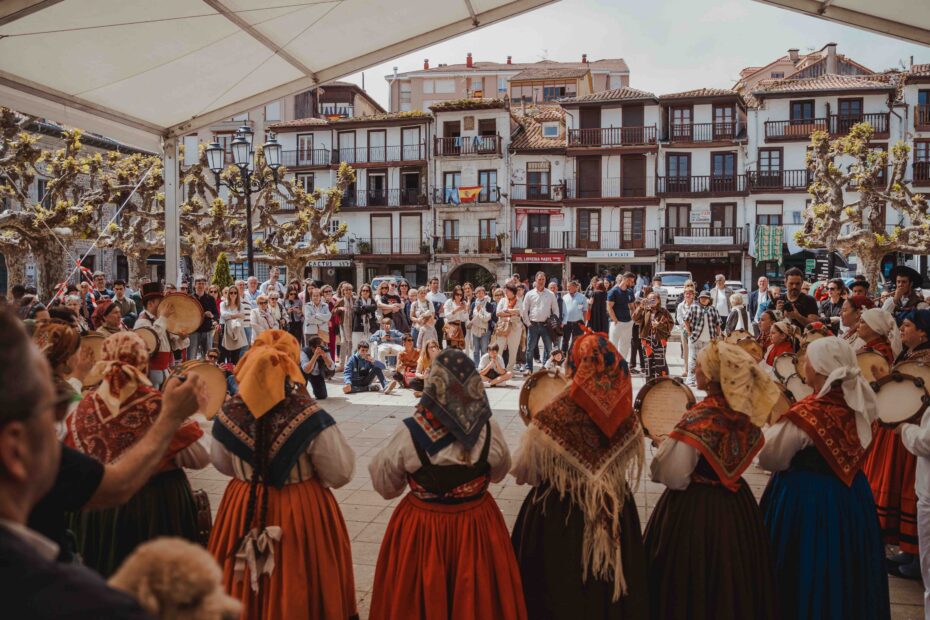
The Folía is one of the most important events in the Cantabrian festive calendar and one of the most unique maritime processions in our country. An event that is felt, heard and lived with an intensity that only those who have had the opportunity to experience it can understand. It is recognized as a Festival of Regional Tourist Interest.
Every year, music brings residents and visitors together again. The devotion to Our Lady of La Barquera and the character of the Patron Saint of Sailors are intertwined with the songs, the tambourines, the choirs and the sound of the sea.
The music of La Folía: when the sea also sings
The music of La Folía becomes an extension of the seafaring environment itself, from the first bars on dry land to the explosion at sea, accompanying, guiding and thrilling the attendees.
In fact, the presence of the “Picayas” is one of the most distinctive elements of the festival. The young women, dressed in navy blue and white and accompanied by decorated tambourines, interpret traditional songs or picayos that have been passed down from generation to generation.
Simple melodies, but deeply emotional that accompany key moments such as the arrival of the statue of Our Lady at the port or its embarkation on the fishing boat, generating great emotion among the locals.
La Folía’s leisure programme: music, tradition and joy in the street
In addition to the maritime procession, the leisure program of La Folía features many other activities. For several days, San Vicente de la Barquera is transformed into a living stage where music and gastronomy become the protagonists.
From the church to the port: the musical journey
The tour begins early in the morning with the Wake-Up Call by the Band of Bugles and Drums, and its classic parade through San Vicente, until it reaches the Church of Santa María de los Ángeles, where the mass takes place. The Barquera Choir participates in the religious service and, once it concludes, the music continues through the streets of the town. In the afternoon, with the transfer of the statue to the port, during the journey, the sounds of bugles, songs and tambourines create a festival atmosphere that is also full of solemnity.
When the Virgin arrives at the port, the music changes and becomes more open and cheerful. It is the prelude to embarkation and the grand maritime procession.
The procession on the high seas: the most awaited moment
The high point of the celebration is the moment when the statue of Our Lady of La Barquera is loaded onto a boat decorated with flowers and flags. Dozens of boats accompany the crossing while sirens, songs and cheers sound.
When Night Falls: The Music of La Folía Invites You to Dance Until You Drop
The music in La Folía does not stop when the procession returns to land. On the contrary, it becomes more festive and carefree. From noon, and as the evening approaches, the streets are filled with traditional rhythms and popular melodies that invite you to stay a while longer, with Raíces Barquereñas and the town’s Folklore School. A party that lasts well into the night with the orchestras and the disco in the Plaza Mayor del Fuero, where fatigue takes a back seat and the body endures… empowered by the music.
It’s okay if you don’t know how to dance, you just have to let yourself go.
Cultural tourism: music, landscape and living tradition
La Folía is also a benchmark for cultural tourism in Cantabria, combining heritage, landscape and tradition.
The surroundings of Oyambre Nature Park and the Saja Nansa Valley offer an incomparable setting for the celebration, allowing you to enjoy a wide range of routes, active tourism options and spectacular views of the coast.
Gastronomy and sounds of the north: the perfect end to the experience
We cannot talk about La Folía without talking about gastronomy. Music also whets your appetite. In fact, music, food and parties form an inseparable whole. In the streets of San Vicente it is common to find options such as the Sorropotún (especially in the summer months with the arrival of the coastal tuna of the North) which, without a doubt, you must try. And there is no better way to understand a culture than by experiencing it with all your senses.