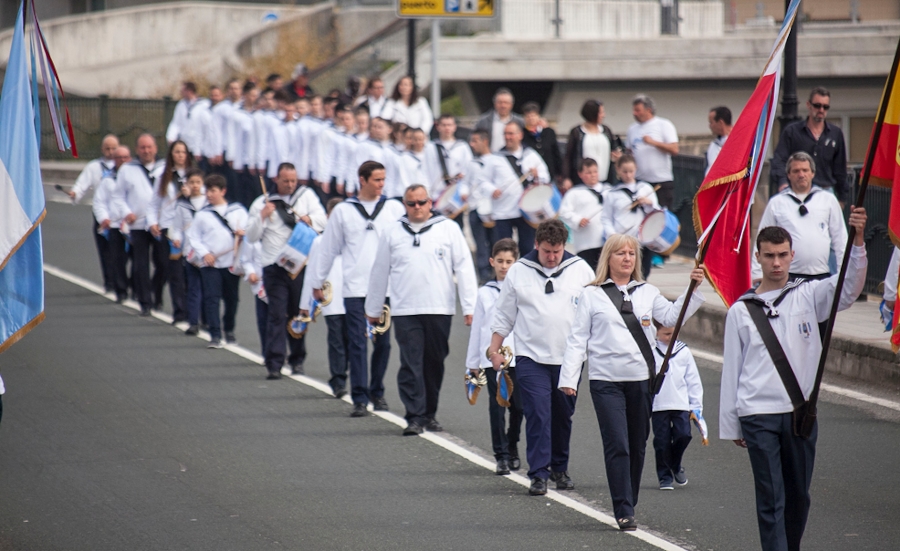
The Folía is much more than a procession: a ritual full of seafaring tradition and soul in which the whole town participates. Throughout the weekend, the town is transformed and the music, costumes, decorations and songs combine to create a unique atmosphere.
The Sanctuary of La Barquera
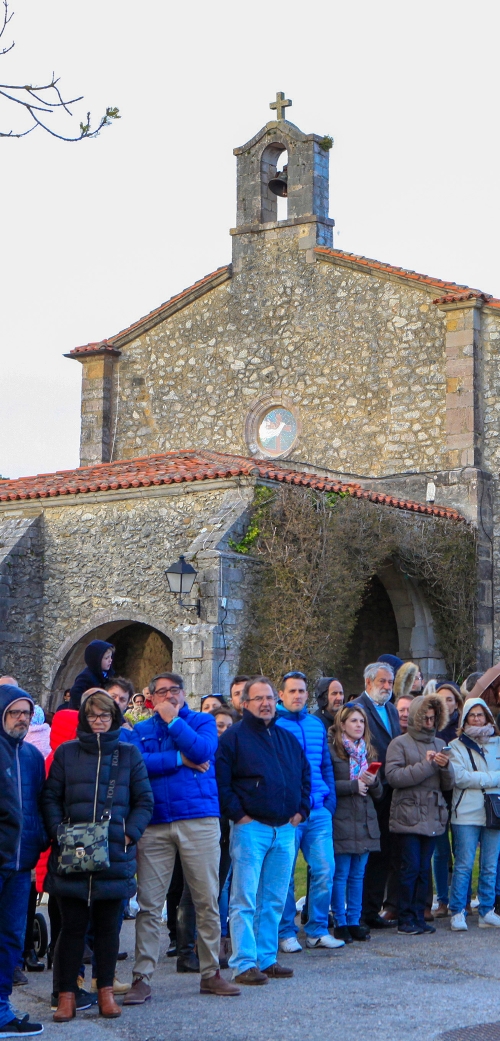
The Sanctuary of Our Lady of La Barquera is one of the municipality’s most emblematic spaces and the key point where the procession begins and ends by land and sea. Its simple architecture, in traditional Cantabrian style, is marked by a humble design that reflects the church’s original function: to serve as a spiritual refuge for fishermen and sailors. The interior is austere, with a main nave that leads to the small altarpiece featuring the alcove housing the image of Our Lady.
In addition, the Sanctuary is located right at the entrance to the port, which enables you to enjoy a spectacular panoramic view of the bay, Merón Beach and the river mouth. A place that is not only important during La Folía, but also throughout the year, as many people come there to make promises, give thanks for favours received or simply enjoy the tranquillity of the estuary.
The current Renaissance building of the sixteenth and seventeenth centuries was erected and enlarged on the site of an earlier one from the twelfth century. The original chapel points to the tradition that it was erected in the very place where the sacred statue made its appearance, where the boat ran aground, on the rocky coast where the boulders were thrown onto the beach by the waves, giving it the look of a simple, rustic construction, with a piece of rock from a Cantabrian reef used as an altar.
According to the historian Valentín Sainz, the historical evidence of the origins of the Sanctuary is found in the parchments kept in the parish archive, specifically, the one marked with the number 27, granted by King Juan II (February 22, 1429), which specifically names the Church of Santa María de la Barquera; it even provides details of the solemn meetings that the then very powerful Brotherhood of the Lord of San Vicente de la Mar held in its adjoining hostelry. Subsequently, on January 17, 1454, Pope Nicholas V, by means of his Religionis Zelus Bull, authorised the Franciscan Friar Juan de la Trecha to live there perpetually with other friars of the same Order. They remained there for 14 years before moving to the Convent of San Luis.
Our Lady of La Barquera: history, statue and attire
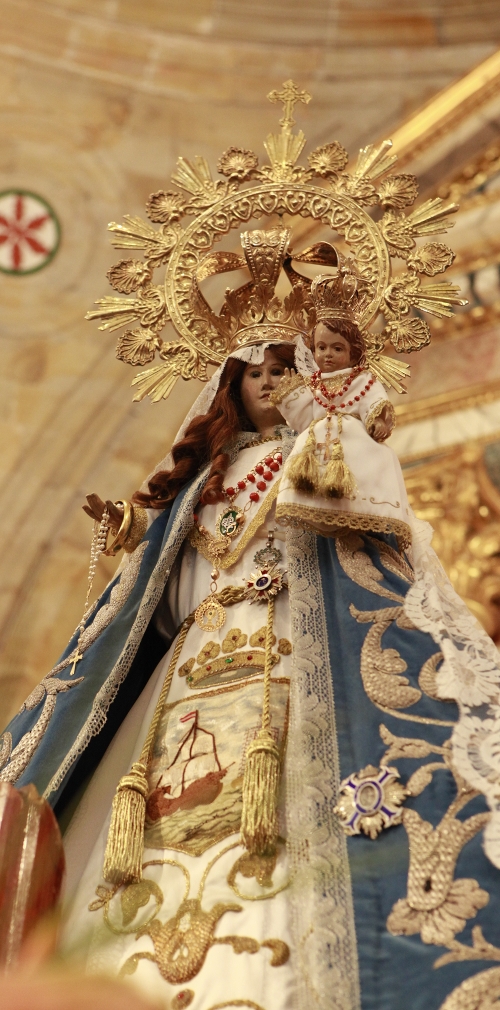
The undisputed protagonist of the festival is Our Lady of La Barquera. According to P. Fernández Regatillo, it is a wood carving, which is now dressed, although some very old traces of paint can still be perceived as proof of its antiquity. Her white dress is embroidered with the coat of arms of San Vicente, a ship under full sail breaking a chain. A privilege granted to the town in memory of the breaking of the bridge of Moorish boats attached with chains that the Saracens put across the Guadalquivir to prevent the Christian conquest of Seville. She wears a mourning mantle on Holy Saturday and blue on La Folía Sunday.
Our Lady is considered the protector of sailors and those who work at sea. In fact, in the Sanctuary we can see a large number of votive offerings, photographs and offerings that have been brought by the locals over generations, both to ask for protection and to give thanks for favours received.
Coronation and recoronation
Our Lady of La Barquera was canonically crowned on September 8, 1929, by the Nuncio of His Holiness, Monsignor Tedeschini, assisted by the Bishop of Santander, Don José Eguino y Trecu, and the Bishop of Ciudad Rodrigo, Don Manuel López de Arana, as well as the Bishop of Zamora. Organized with great solemnity, the coronation took place in the afternoon, after Our Lady had been taken in a procession through the streets to embark “on the prow of the largest of the ships,” and right there the Nuncio crowned her, after having crowned the Baby Jesus. At that moment the flag was raised on the bow, breaking the excited silence with a salvo of sirens, clapping and rockets.
On April 16, 1950, the Virgin was crowned again, with Don Jerónimo Gómez as parish priest, in the presence of the authorities of Santander and the Bishop of Oviedo, Don Francisco Javier Lauzurica y Torralba, with the whole town contributing to buy a crown and mantle, after their loss during the Spanish Civil War, and Baby Jesus she held in her hand.
The "picayas" and "picayos": music, tradition and emotion
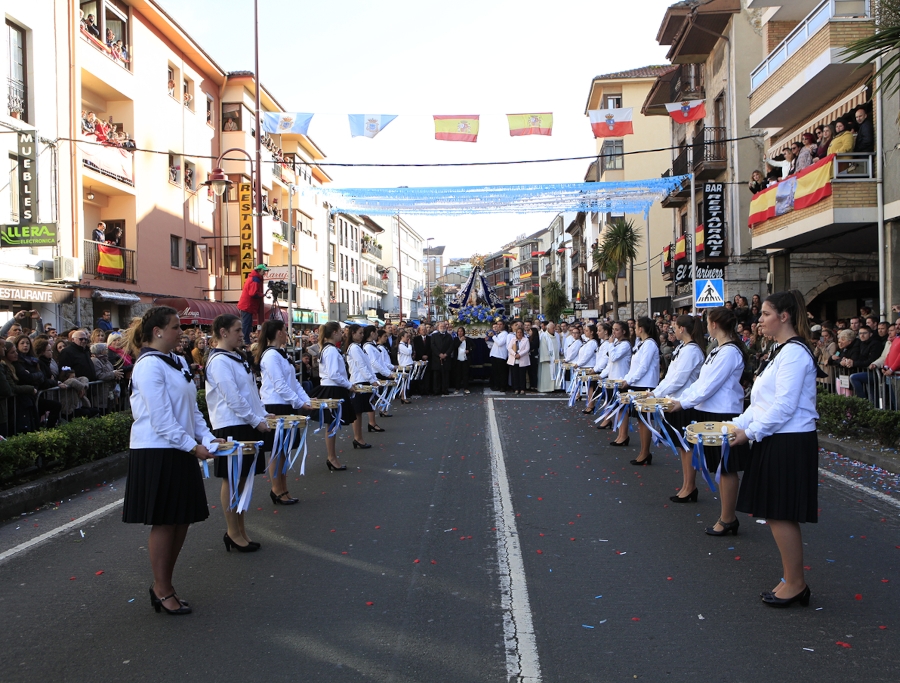
The participation of the young “picayas” is one of the highlights of the procession. These young women dressed in white and blue interpret the picayos (traditional songs) that are performed during the festival of La Folía to the rhythm of their tambourines adorned with blue and white ribbons.
The songs or “picayos” are based on simple but intense melodies, which accompany both the land procession and part of the maritime route. The best-known lyrics feature stanzas that the older residents have learned by heart:
“Oh, what can that reflection be
that comes here to enlighten us,
it is the Queen of the heavens
that we are going to encounter”
When they are about to leave for the high seas the lyrics below are sung, a beautiful and interesting text, which features a marked style of old, traditional poetry, as a demonstration of the persistence in the oral tradition of ancient lyrical and traditional songs:
“Dock sailor, dock at the port,
since the Virgin Mary wants to embark”
When docking or returning in procession, various songs are sung:
“When the sailor at sea lifts up his prayer to You,
Help them Oh Mary, do not forget that you are their Mother!”
Once she arrives back at the chapel, the young people fervently receive her and place her back on her centuries-old throne, while the people bid farewell to their Queen and Mother repeating the stanzas of the last picayos:
“Oh, Mother! Tend to the wind,
Sailors and Our Lady of La Barquera:
Sailors, sing to Mary,
at Easter,
celebrating the joyful Folía
who returns to her old mansion.
La Barquera is the sacred forest
where the mother of God dwells,
La Barquera is the adored name
that Our Lady gave to this Town”
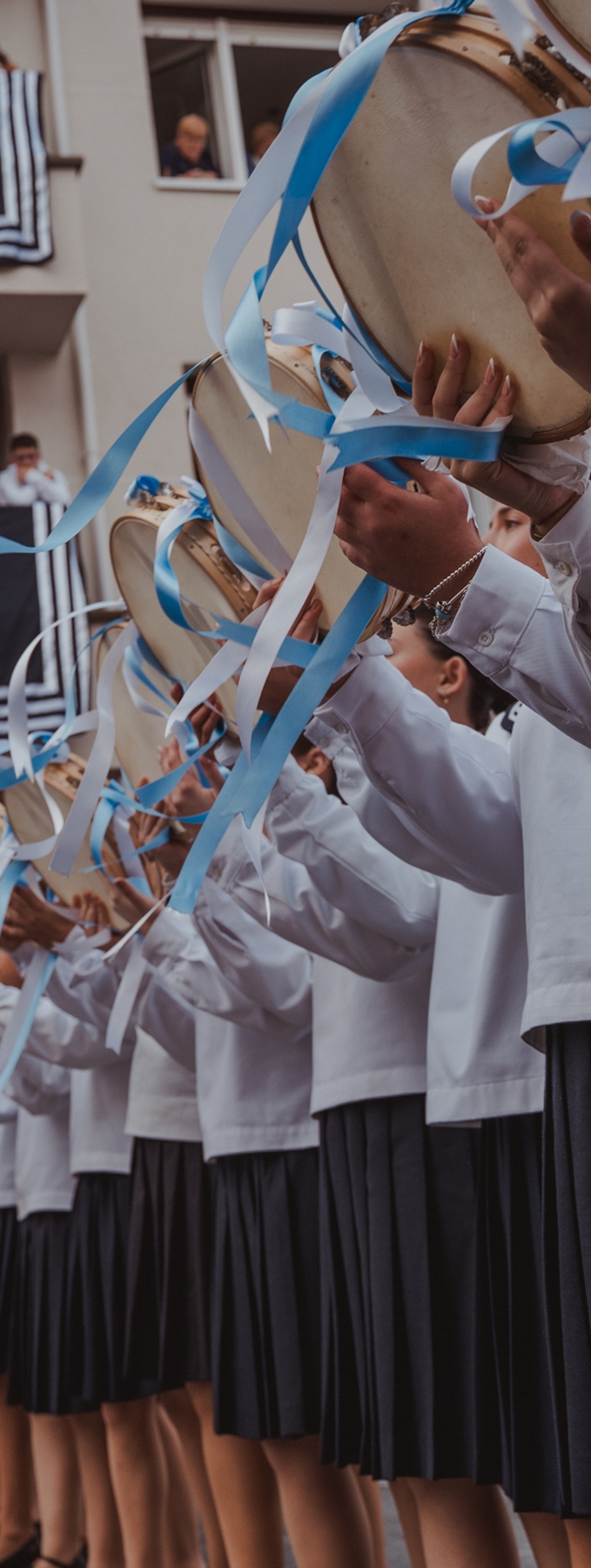
The Fishermen's Guild
One of the most representative elements of the tradition is the Cabildo de Mareantes de San Vicente de la Barquera, an institution closely linked to the municipality’s fishing past, a guild of fishermen and sailors who organized part of the economic and social life of this port on the Cantabrian Sea during the Middle Ages. The oldest preserved ordinances of this Guild date back to 1330. In ancient times it was in charge of guarding the image of Our Lady and organizing its procession on land and sea.
At present, this entity sets the date of La Folía, depending on when Holy Week coincides each year, by virtue of the time of high tide on the Sundays following Easter. It designates and supervises the preparation of the main vessel, traditionally known as “the guide boat.” It coordinates the departure and arrival times to ensure that everything is carried out with the respect and solemnity that has characterized the event for centuries.
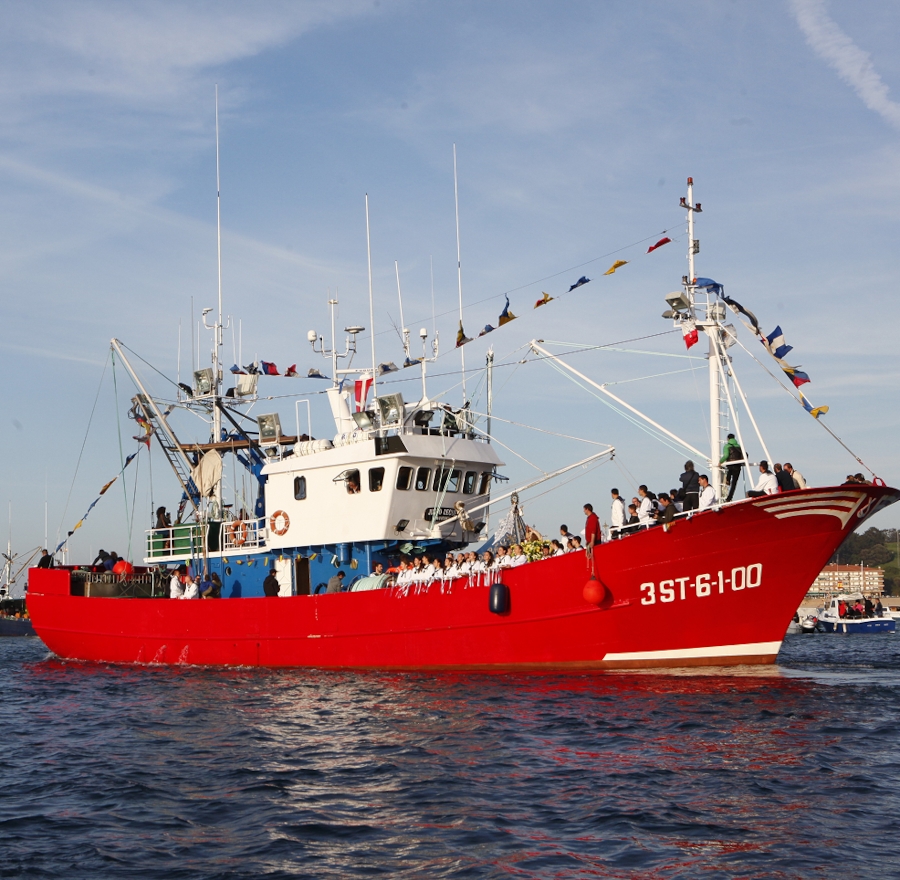
The Brotherhood of Our Lady of La Barquera
The Brotherhood of Our Lady of La Barquera is in charge of guarding the image of the Virgin in its Sanctuary all year round. It organizes the processions in which the town’s Patron Saint is the protagonist, mainly on Holy Saturday, Easter Sunday and La Folía.
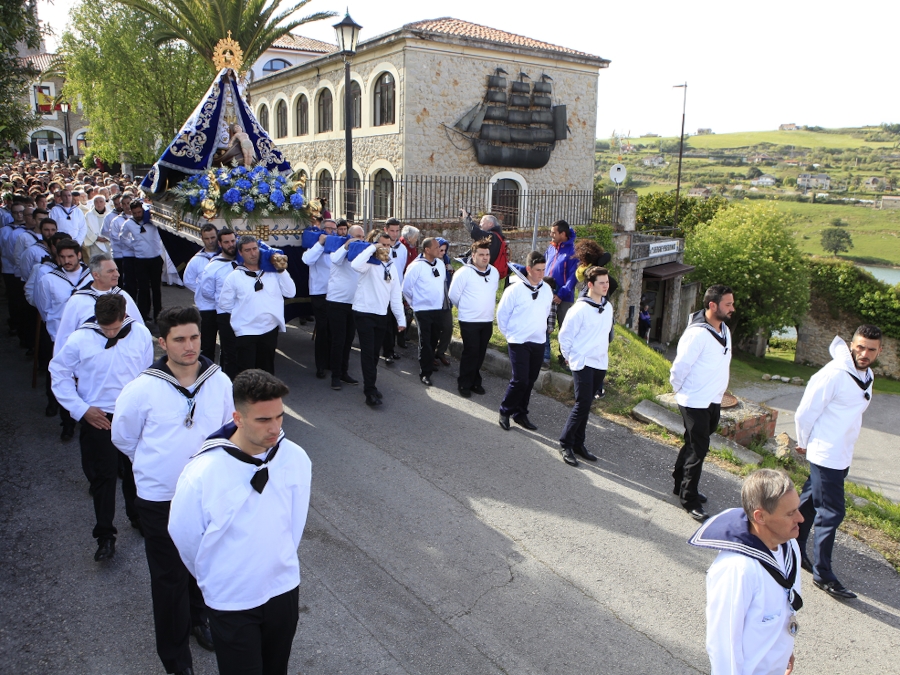
The Band of Bugles and Drums
Before the “picayas” take centre stage, the Bugle and Drum Band leads the procession through the municipality’s streets. Their notes mark the rhythm of the procession, creating expectation among the attendees.
The sounds of bugles and drums are an essential part of the festival’s musical heritage. The marches are usually simple, sober and deeply ceremonial, and their echoes can be heard from the viewpoints, balconies and streets of the historic centre, reinforcing the emotion of the first moments of the procession.